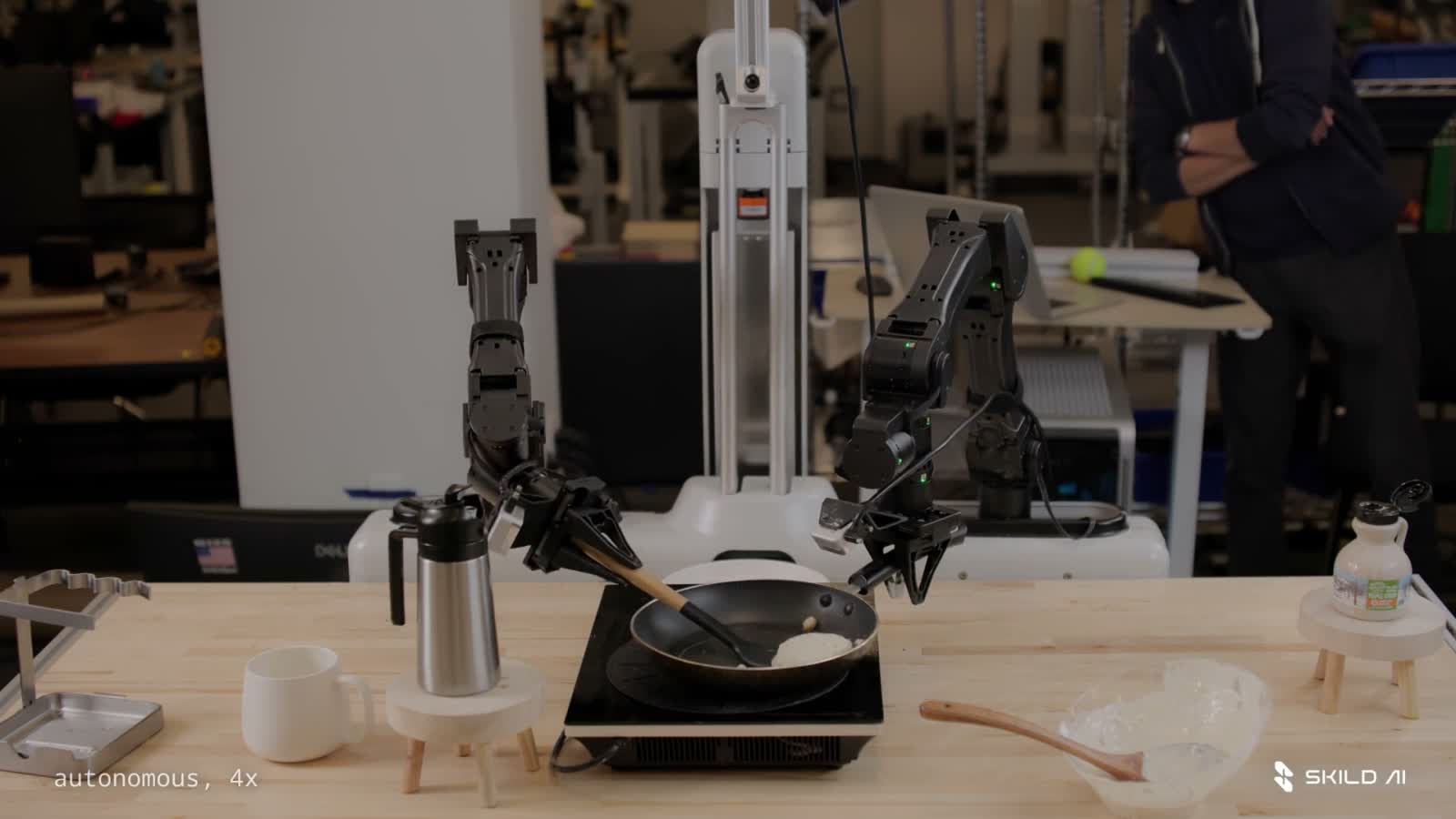
In Skild’s demonstration, robot arms work over a pan and flip a pancake. The footage is labeled as autonomous at 4× playback speed. Behind the memorable cooking clip is a broader claim about how robots can learn tasks.
According to NVIDIA’s account of the work, Skild’s S1 model is designed to learn a previously unseen task from a single video demonstration, without task-specific training updates to its weights.
Teaching by showing
The appealing idea is that showing a robot what to do could become more useful than programming every action separately. A shared model takes the demonstration as context for the task.
That is a company-reported capability, illustrated here by company footage. A short clip does not establish how reliably the robot handles every kitchen or every task.
Why it is worth following
Robots operating in changing environments need ways to adapt. Skild’s work puts video at the center of that problem. NVIDIA’s September 10 write-up describes the training and simulation infrastructure behind the model.
Source published September 10, 2026. Coverage is based on the maker’s announcement and demonstration.