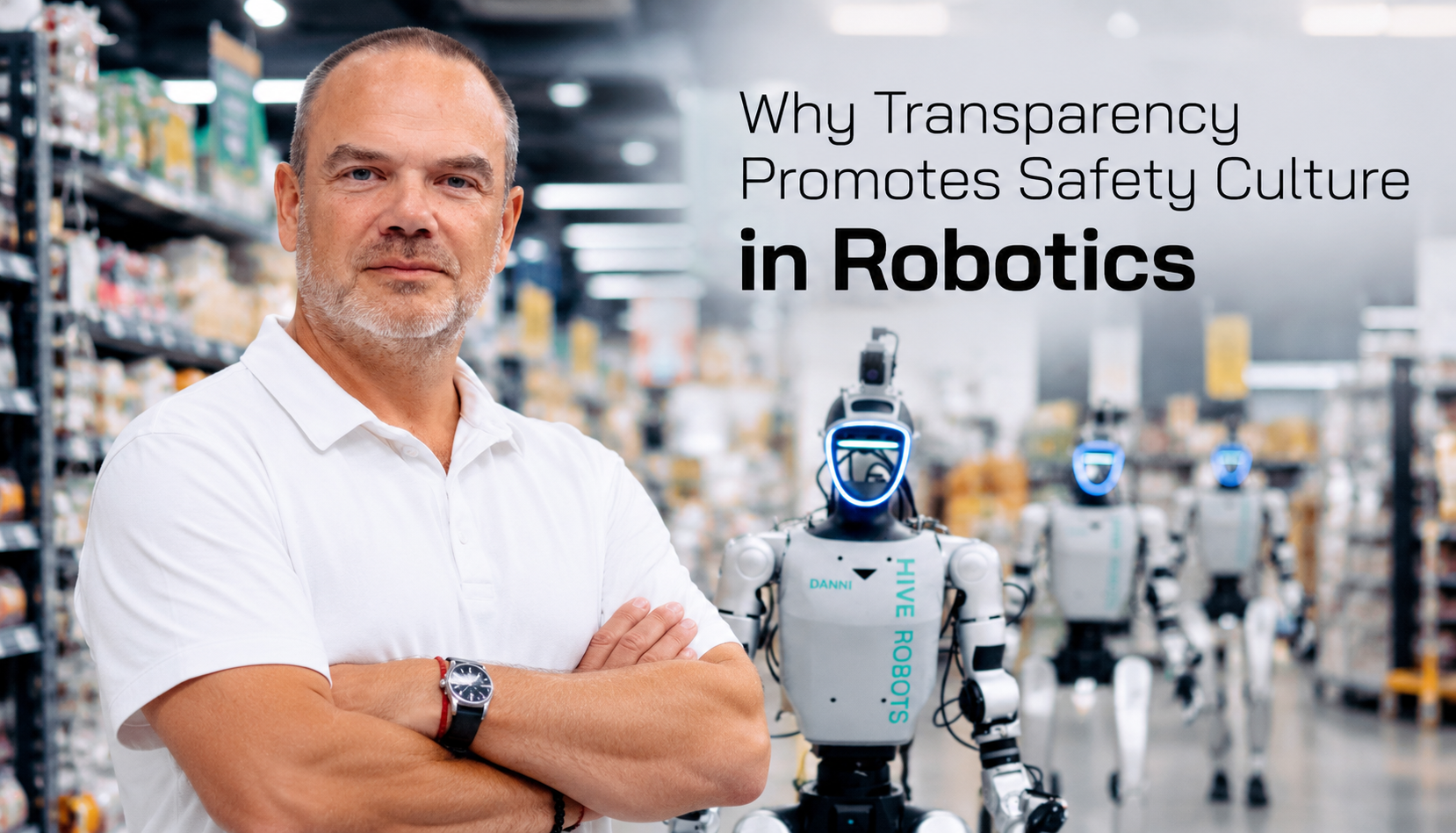
More human-like behavior can make people less cautious
HIVE Robots says its JUST HIVE safety system responds to a humanoid-specific problem: as a robot behaves more naturally, people may approach it and trust it like a colleague. But a walking machine can still experience a sensor fault, software freeze or unexpected joint movement. A safety plan has to account for the machine and for the way people react to it.
The company says JUST HIVE automatically records guard trips, rejected commands and emergency-stop presses. It also asks people to report near-misses, falls and unclear procedures the same day, without punishing honest mistakes. The CEO and safety team review reports weekly and decide what to address first.
A safety case needs evidence, not just a culture statement
HIVE says the system is robot-agnostic and designed to log robot behavior from the ground up to support compliance with European rules. Its comparison is aviation’s ‘just culture,’ where reporting a near-miss is treated as a way to improve the system, not as a reason to hide errors. That philosophy is paired with event logging and regular review rather than presented as a substitute for engineering controls.
The company acknowledges that its robots do not work perfectly yet. That admission is important: reliable deployment requires visible failure handling as much as a polished demonstration. The next proof will be how incident reporting changes operational metrics—what gets caught, how quickly fixes arrive and whether people can work safely around the machines in real deployments.
Source published 2026-10-16. Coverage is based on the maker’s announcement and demonstration.