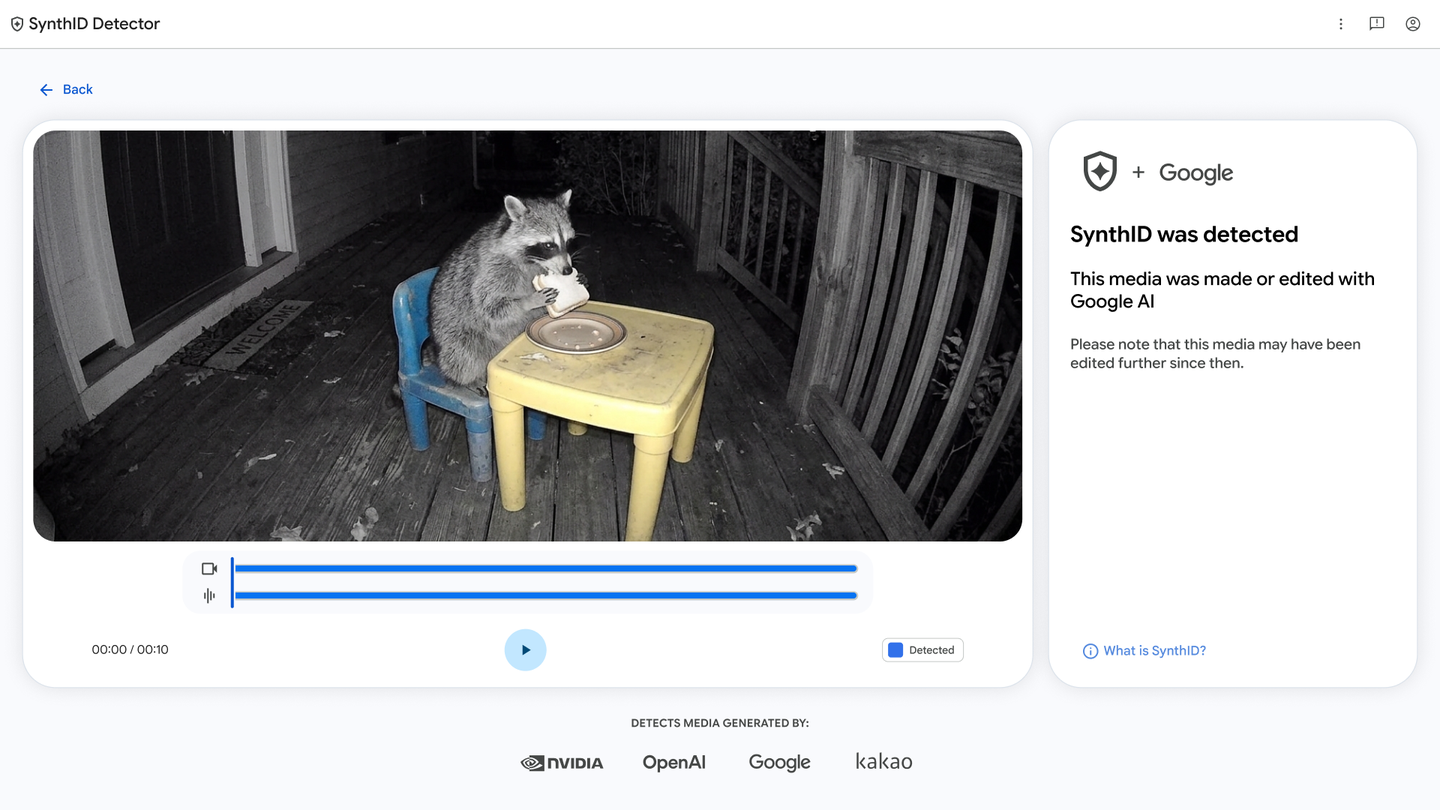
A way to look for a watermark
Google DeepMind has expanded public access to SynthID Detector. Anyone can upload an image, video or audio file and check whether it contains the company’s imperceptible SynthID watermark. Google says the tool is available globally in English and can also identify content from named partners, including OpenAI, NVIDIA and Kakao, with Apple expected later.
Google reports that SynthID has been used on more than 180 billion images and videos and the equivalent of 240,000 years of audio. That scale makes the detector a useful provenance signal for some media. It does not make it a universal detector of AI content: a file created without SynthID, or altered so its watermark is no longer detected, may not be identified by this check.
A positive result answers a narrower question
SynthID is designed to embed a signal in generated media. The detector looks for that signal, rather than deciding from visual style whether something “looks AI.” That distinction is helpful because polished images and unusual audio can be difficult to judge by eye or ear, while file metadata can be removed during ordinary sharing.
The result should be read as evidence about a known watermark, not a verdict about whether a piece of media was made or edited with any AI system. Google’s own announcement says its built-in verification in Search, Gemini and Chrome already handles more than one million requests each day; the public portal extends the same approach to direct file checks.
Where it fits in a verification workflow
If a post contains a suspicious clip, first check where it came from and whether it has been edited. Then run SynthID if you suspect the relevant model family was involved. A match can add useful context; a non-match does not establish that the media is camera-original or human-made.
The broader shift is from relying on people to spot synthetic media to combining provenance clues, source history and verification tools. SynthID is one part of that workflow, with coverage tied to partner adoption. Its value grows as more generators mark outputs and platforms preserve the signals.
Source published 2026-10-07. Coverage is based on the maker’s announcement and demonstration.