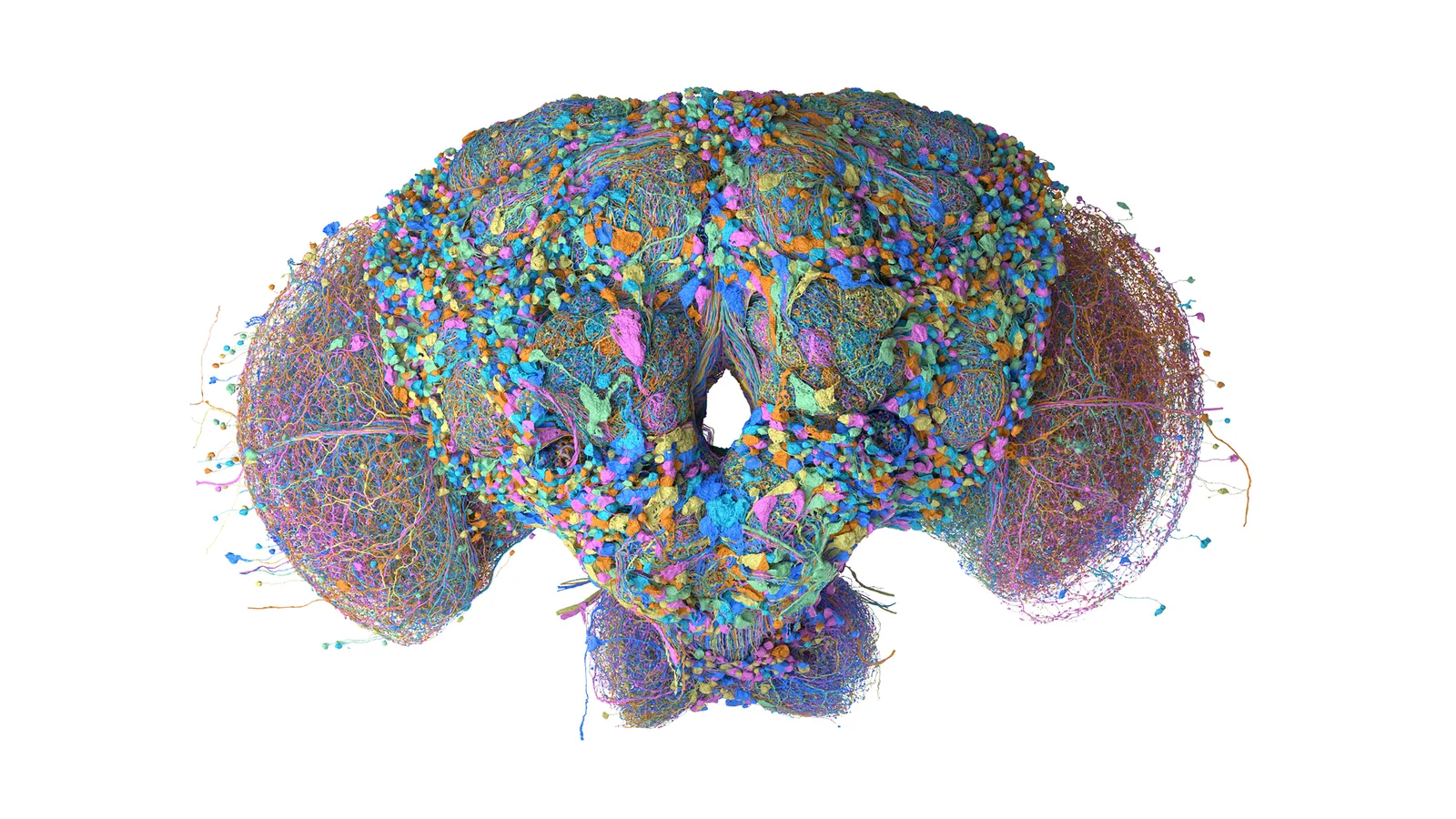
The bright strands in this image are a reconstruction of real neural anatomy. HHMI Janelia, Google Research and collaborators have produced a complete map of a male fruit fly brain, containing more than 166,000 neurons.
The work builds on the earlier female brain map. Researchers also classified 11,691 neuron types across the central nervous system.
From slices to a three-dimensional map
The team started with thin tissue sections and millions of two-dimensional images. Computers and AI helped reconstruct neural shapes in three dimensions, with experts contributing classification and interpretation.
Think about the difference between a stack of sliced views and an object you can trace through space. Reconstructing those continuities is what turns a large image collection into something researchers can explore as a connected structure.
A map for new questions
A wiring diagram gives researchers a more detailed foundation for studying movement, sensory input and behavior. They can investigate which routes might connect a stimulus to an action.
It is a structural resource, not a complete explanation of a mind. Its value is in making better, more specific experiments possible—and the image makes the scale of that work immediately visible.
Source published September 3, 2026. Coverage is based on the maker’s announcement and demonstration.