What changed
Archon Robotics frames humanoid progress as a systems problem. Its July paper argues that a useful foundation model must connect task semantics and planning to perception, body state, motion generation and the controller that actually keeps a robot balanced.
The company sketches four layers: a task-and-world model for goals and replanning; a native humanoid model for multimodal state and action intent; a motion-prior layer for feasible movement under constraints; and a low-level tracker for balance, contact and force limits. The distinction is practical: a language model can decide what should happen, but the physical stack must make the movement executable on a particular body.
What the result actually shows
Archon says its approach combines human motion data, robot data, simulation and deployment feedback. The proposed benefit is transfer and recovery: if a robot encounters new contact, a changed sensor or an imperfect action, the full system should use those signals rather than depend on a hand-built routine for every task.
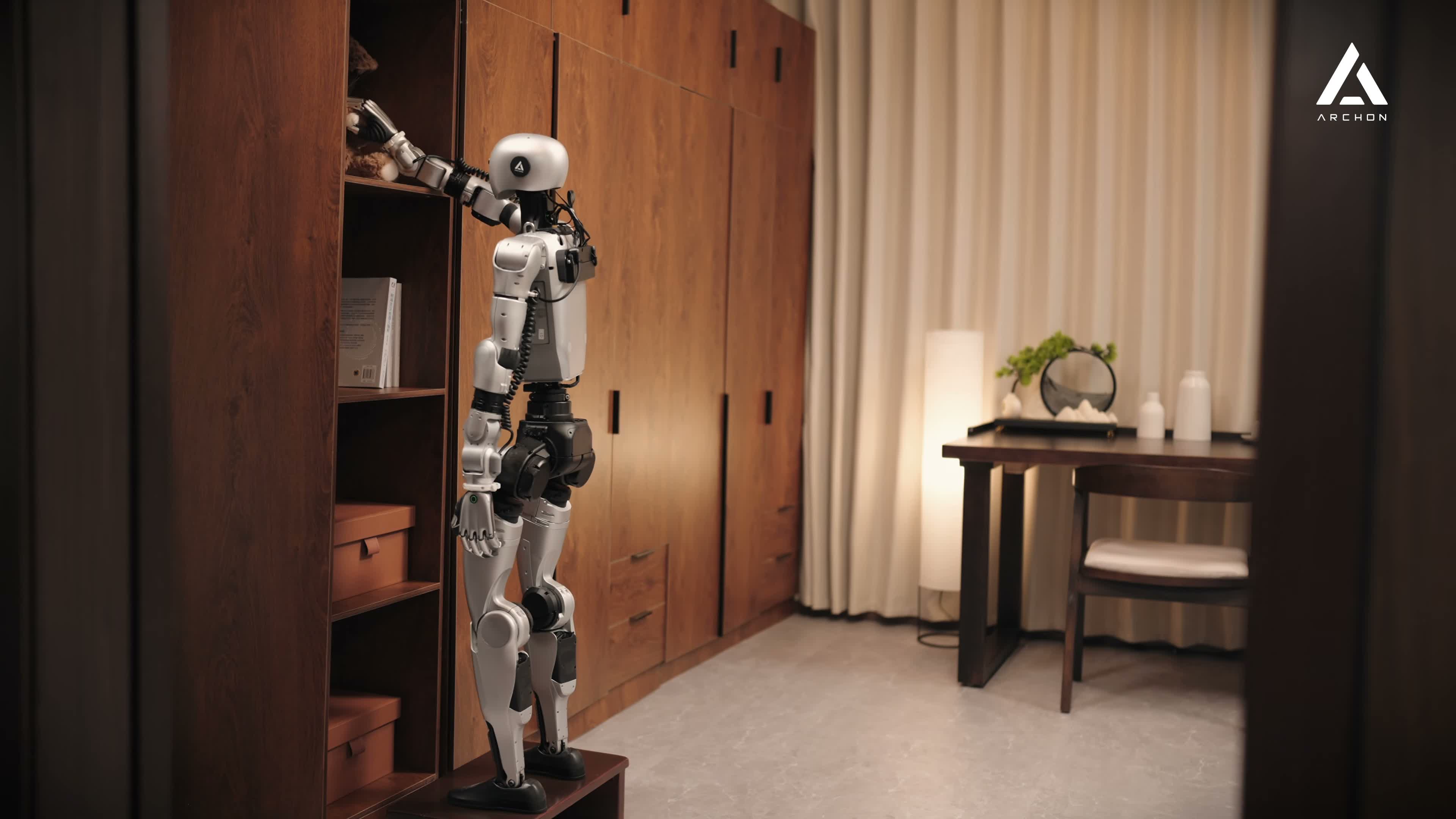
This is a company’s research framing, not proof of generalized humanoid reliability. Archon itself says the meaningful measure is whether capability improves with scale, transfer and recovery—not whether one polished clip looks impressive. The architecture is a useful lens for evaluating future demos: watch the entire action chain, including balance and correction.
Source published 2026-07-13. Coverage is based on the maker’s announcement and demonstration.