The demos are starting to look like finished experiences
The strongest Opus 5.5 examples this week are not just code snippets. Creators are showing projects with a playable loop, a world to explore or an edited visual payoff. Each demo is creator-made; we did not independently reproduce the builds.
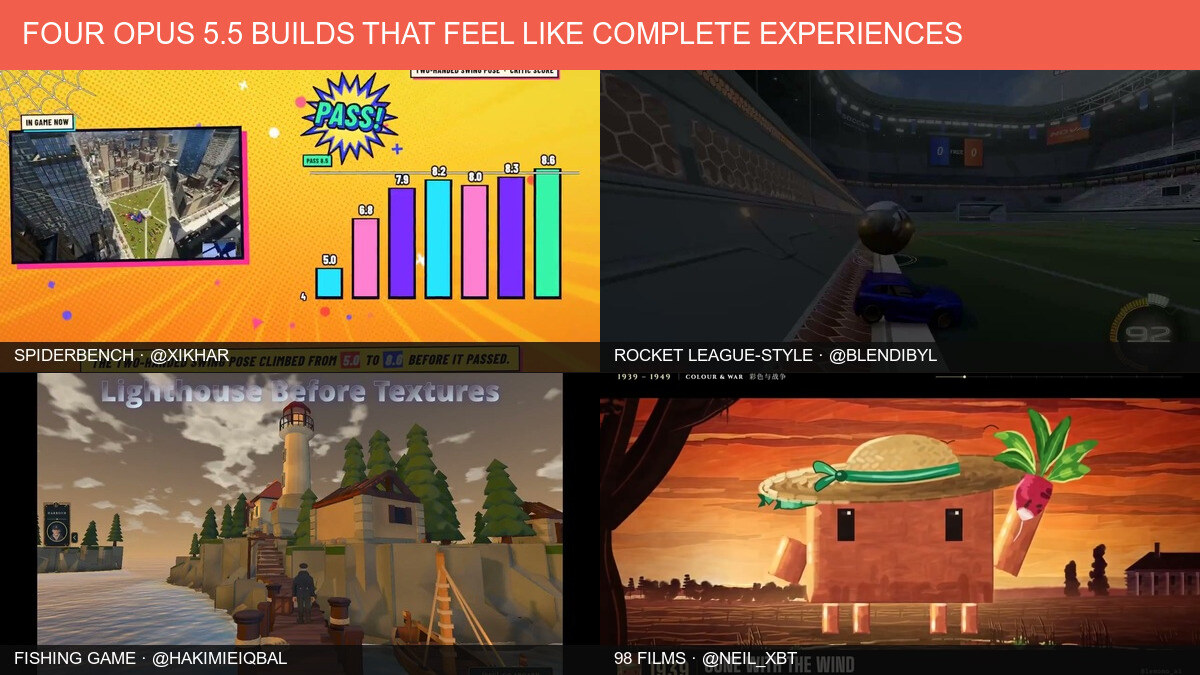
Shikhar (@xikhar) shows Spiderbench, a game-agent benchmark made with Opus 5.5 and Three.js. The video moves from generated game scenes to agents playing and receiving critic scores. The useful idea is the feedback loop: create a task, let agents attempt it, then compare results. That is different from saying the model autonomously built a complete commercial game. Original demo: https://x.com/xikhar/status/2104717572788883829
A familiar game becomes a browser experiment
Blendi Byl’s Rocket League-style clone puts a car, ball, arena and boost controls in a browser-playable scene. Blendi says he used Opus 5.5 to build the unofficial fan project. Matt Collison’s quote-post describes a WASM Rocket Sim component in the implementation; that does not mean the model recreated Rocket League’s full engine from scratch. The visible takeaway is how quickly a familiar interaction can become a playable prototype. Original demo and creator’s description: https://x.com/MrCollison/status/2104843514739589243
A fishing game takes AI into the whole production pipeline
Hakimi Eiqbal’s week-nine update shows a fishing-game project spanning environments, character assets and scenes. He describes using AI for most of the coding and sound design, with ElevenLabs for audio. The clip includes work in progress as well as the world itself, so this is a builder’s ongoing project—not a one-prompt, finished game claim. Original demo: https://x.com/hakimieiqbal/status/2104910311983616340
The same model can help make a complete visual piece
NeilXbt’s 6½-minute sequence redraws all 98 Best Picture winners in styles that fit each film, then assembles them into a narrated, scored timeline. The creator says Opus 5.5 wrote code for the visuals, music and editing. It is a useful counterpoint to the game demos: the output is not an app, but a finished piece with an editorial through-line. Original video: https://x.com/neil_xbt/status/2104847145291690190
What changed
These examples suggest a shift from asking a model for one function toward directing a small production workflow: generate assets, assemble them, test what works, and present the result. The human contribution remains visible in the idea, iteration and final judgment. The practical bar is also clearer: a compelling demo should show the thing working, not only promise what the code might do.
Source published September 29, 2026. Coverage is based on the maker’s announcement and demonstration.