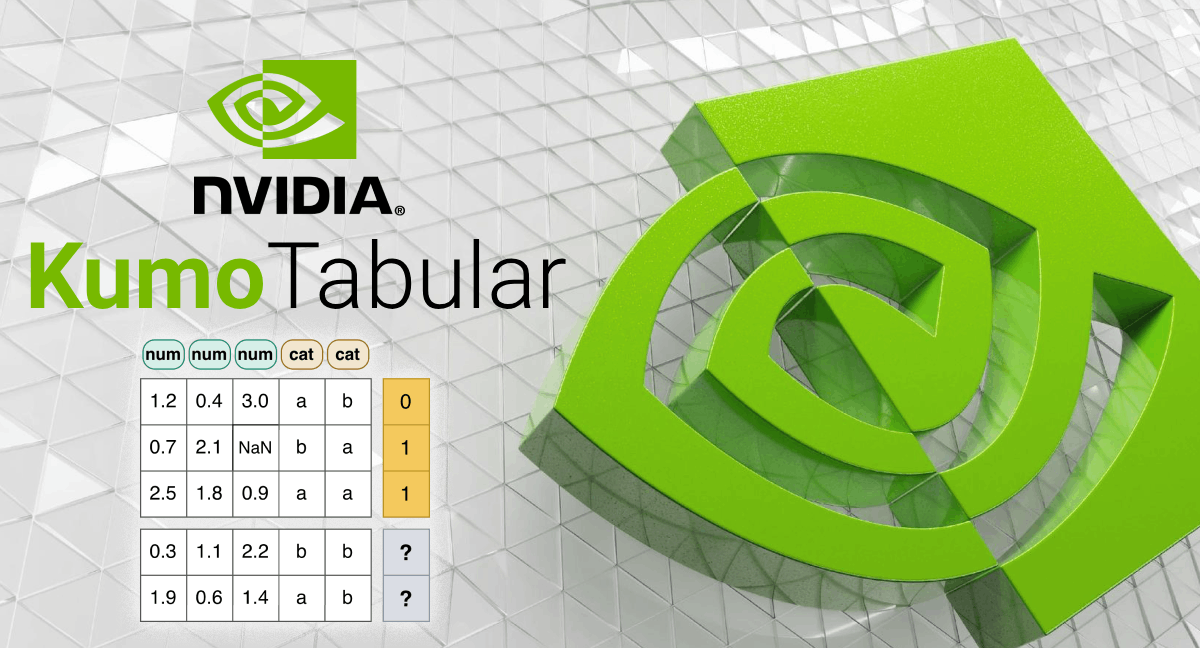
A table can act like the prompt
NVIDIA’s Kumo Tabular is a foundation model for classification and regression. Give it a table with example rows and known labels, plus new rows to score, and it returns predictions in a single forward pass. The workflow is closer to in-context learning than the familiar process of training a separate model for every dataset.
That is relevant to common work hidden in spreadsheets and databases: estimating demand, sorting claims, predicting churn or flagging transactions. The model is not a general assistant that understands arbitrary sheets. Its supported inputs are numerical and categorical columns, with separate models for classification and regression.
What NVIDIA says it changes
Kumo Tabular is available as open weights and code in three sizes from 28 million to 215 million parameters. NVIDIA says it was pretrained on synthetic tables, so a new task does not require fine-tuning or a feature-engineering pass before inference. The released code handles table preprocessing and predictions, and the model is offered under the OpenMDW-1.1 license for commercial use.
The striking part is how small the released models are compared with general language models. The training recipe teaches the system patterns across many generated tables; it is then asked to infer relationships from the labeled examples supplied at use time. NVIDIA says its training covered tens of millions of synthetic tables, with larger versions seeing more generated examples.
The benchmark claim is broad, but vendor-reported
NVIDIA reports Kumo Tabular ranked first on TabArena, BeyondArena, TALENT and ScoringBench. On TabArena, NVIDIA reports an ELO score of 1,950 and a 17-times speed advantage over LimiX-2 under its single RTX 6000 Pro evaluation setup. That is a substantial claim, but it comes from the model developer’s evaluation and a specific hardware setup.
The comparison is useful as a signal to investigate, not a guarantee that the model will beat a tuned solution on your own data. A leaderboard average can hide dataset-specific results, and runtime comparisons depend on hardware and configuration. The source article includes the benchmark details and an executable example so developers can inspect the methodology.
Where it may fit—and where it may not
The simplest test is a held-out slice of a real table. Keep a separate test set, compare against a baseline you already trust, and check calibration as well as accuracy. The model’s predictions can degrade when query rows come from a different distribution than the examples in context; NVIDIA calls out that distribution shift as a limitation.
If the table is mostly text, images or timestamp sequences, this is not a drop-in answer. Those signals need to be converted into supported features first. For teams that repeatedly build tabular predictors, though, the interesting promise is a reusable starting point that can score a new task without beginning with a bespoke training pipeline. Learn more: https://huggingface.co/blog/nvidia/kumo-tabular.
Source published September 29, 2026. Coverage is based on the maker’s announcement and demonstration.