Agents enter the ROS workflow
Robot developers use ROS as a common foundation for connecting sensors, perception, motion planning and control. NVIDIA’s Isaac ROS 5.0 release adds agent-ready documentation and reusable skills intended to help both people and coding agents move from an instruction to a working robotics application.
The skills cover setup and manipulation. NVIDIA also describes a FoundationStereo fine-tuning workflow that can adapt stereo perception to a developer’s cameras, environment and application. A separate pick-and-place skill bundles detection, depth estimation and pose output into a reusable workflow.
A measurable speed claim
NVIDIA says FoundationPose, its model for object pose estimation and tracking, can provide position and orientation estimates up to 5.5 times faster through an agent-ready inference library. That could help a robot keep track of objects as they move, which is a prerequisite for flexible handling.
The figure is NVIDIA’s reported maximum, not a benchmark that applies to every sensor, scene or robot. The release is free and open source, and NVIDIA positions it as part of a larger ROS ecosystem with about 1.3 million users.
What the Intrinsic example demonstrates
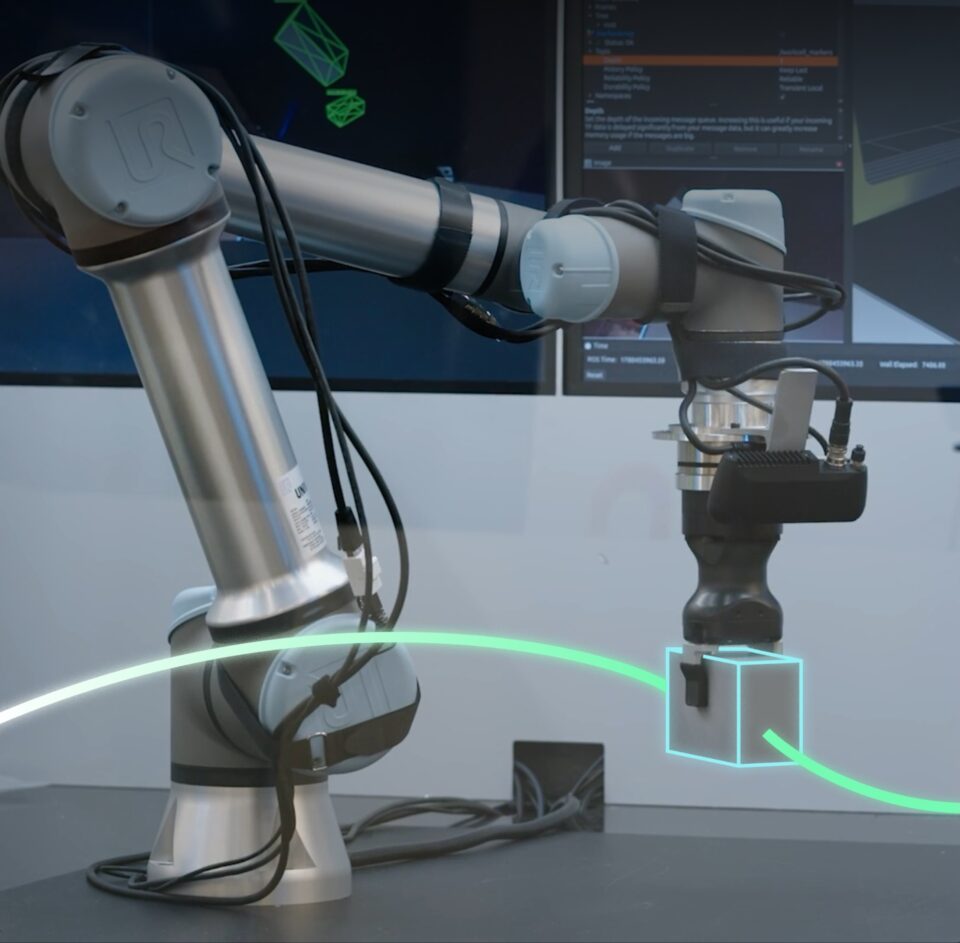
One accompanying example is Intrinsic’s open machine-tending application. It uses FoundationPose to detect and handle parts for CNC machines, with the goal of reducing dependence on rigid fixtures and specialized integration. The source image shows an industrial robot using perception to locate an object.
The important distinction is that Isaac ROS provides building blocks and reference workflows. A developer still has to configure a cell, select sensors, validate safety and adapt the stack to the production task. The release does not mean an agent can autonomously deploy arbitrary factory robots from one prompt.
Why reusable robot skills matter
Software agents are most useful when a task can be decomposed into clear steps and checked against a real system. Robotics adds the physical constraints: a wrong frame, bad depth estimate or unsafe motion can have consequences beyond a failed build.
NVIDIA’s approach packages common ROS work into workflows and makes its documentation easier for agents to follow. That could lower setup friction while keeping robot-specific testing in the loop. The open source availability lets developers inspect and extend the components rather than treating them as a sealed service.
Source published 2026-09-22. Coverage is based on the maker’s announcement and demonstration.