Why copying a video is hard
A human video shows where a person moves, but not the forces required to get a robot through the same motion. Directly tracking a reconstructed pose can produce states that are dynamically impossible for a machine. The KungfuAthleteBot paper focuses on that gap between a visual reference and a physically feasible action.
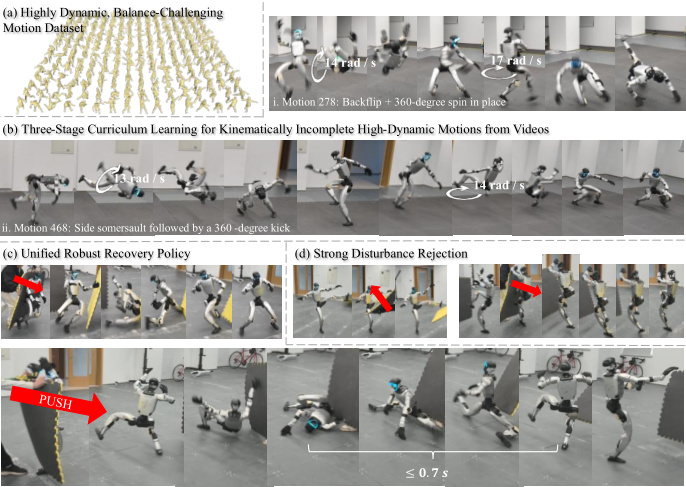
The authors introduce physics-driven sampling to start training from states with lower kinetic energy, then let the policy discover motions it can actually execute. The approach is meant to keep the visual target while accounting for the robot’s body and dynamics.
One policy for motion and recovery
The team trains dynamic skills and disturbance recovery in the same policy, without a separate recovery reference dataset or manual mode switching. The authors report that the robot recovers from arbitrary falls in about 0.7 seconds, which they describe as the fastest recovery reported for a unified policy.
That number is a result from the paper’s experiments, not a guarantee for every fall, surface or robot. The useful design idea is the unified controller: the system does not have to leave its learned motion policy and invoke a separately scripted recovery mode.
A path toward more physical demonstrations
Learning from human video could expand the motion examples available for robots, but only if the system can translate them into actions its hardware can safely perform. A realistic training method has to account for dynamics rather than treating a body pose sequence as a direct command.
The paper’s demonstrations are research results. The next question is how well the approach handles new motions, unplanned contact and repeated falls outside the selected tasks. Still, it gives a clear example of video-based robot learning tackling not only performance, but also recovery.
Source published October 2, 2026. Coverage is based on the maker’s announcement and demonstration.