One robotics stack, several kinds of work
NVIDIA Isaac ROS 5.0 is a set of GPU-accelerated open-source packages built on ROS. Its update adds agent-ready skills and documentation alongside support for ROS Lyrical and Ubuntu 24.04. NVIDIA’s examples are useful because they show how the software connects to different machines: a robot arm tending a CNC machine, a humanoid interpreting scenes, and an industrial system being tested against simulation.
The demonstrations are company-reported integration examples, not a controlled comparison of robot performance. Their common thread is the software path from perception to action: recognize objects, estimate pose, plan movement, and run the workflow on robot hardware.
A machine-tending cell can adapt to part placement
Intrinsic’s Open Machine Tending Solution is a reference application for CNC machine tending. NVIDIA says it combines Intrinsic Core with FoundationPose so a robot can register, track and handle parts without depending on rigid, costly physical fixtures. The practical benefit is flexibility in the cell: the robot can reason about a part’s pose rather than assume that every piece is placed in exactly the same location.
NVIDIA describes this as an open-source suite of preconfigured runtime services, not a turnkey installation for every factory. Integrators still need to validate the camera, part geometry, robot motion and safety requirements for their own line.
MenteeBot uses the stack for on-robot perception
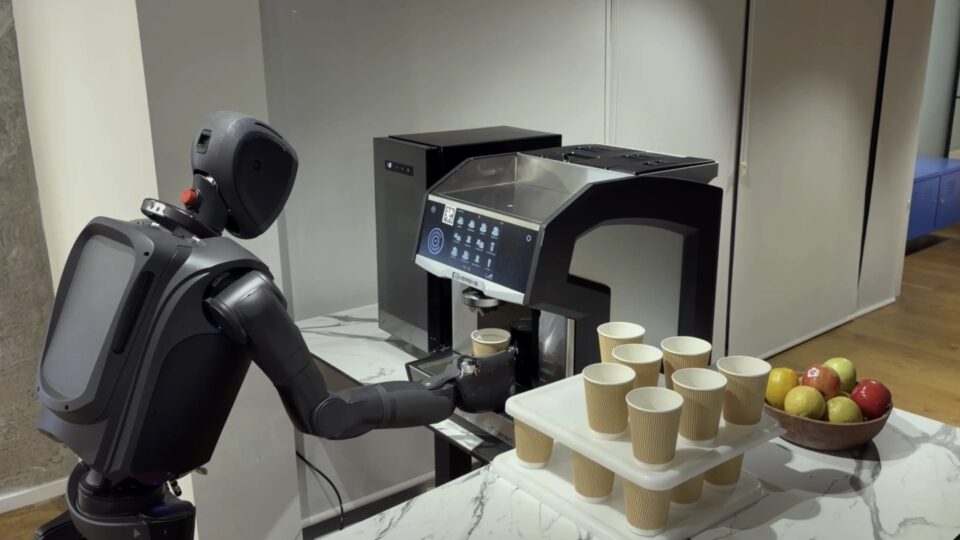
Mentee Robotics says Isaac ROS supplies the perception and AI backbone for its MenteeBot humanoid, helping it interpret visual information and execute learned behaviors in real time. NVIDIA highlights a shared software foundation across Jetson Orin and Jetson Thor, giving the company a route to carry work between existing and next-generation robot hardware.
That matters because each new robot computer can otherwise force teams to rebuild and retest a different perception stack. NVIDIA’s source describes a development path; it does not publish a public throughput or task-success figure for MenteeBot in this post.
Magna brings simulation into manufacturing validation
Magna’s example combines Isaac ROS with synchronized data collection and Isaac GR00T model deployment, then uses Isaac Sim for hardware-in-the-loop testing. The idea is to exercise a robot workflow against a digital setup before relying on it in a manufacturing or mobility environment. NVIDIA presents this as a way to develop faster with fewer deployment risks; the article does not quantify a measured reduction.
Together, the three examples show why the robot story is not only about a new humanoid video. Open tooling, perception models, simulation and motion planning are becoming the connective tissue that lets different machines use AI in a physical workflow. Source: https://blogs.nvidia.com/blog/isaac-ros-5-0-agentic-open-source-robotics/
Source published September 22, 2026. Coverage is based on the maker’s announcement and demonstration.