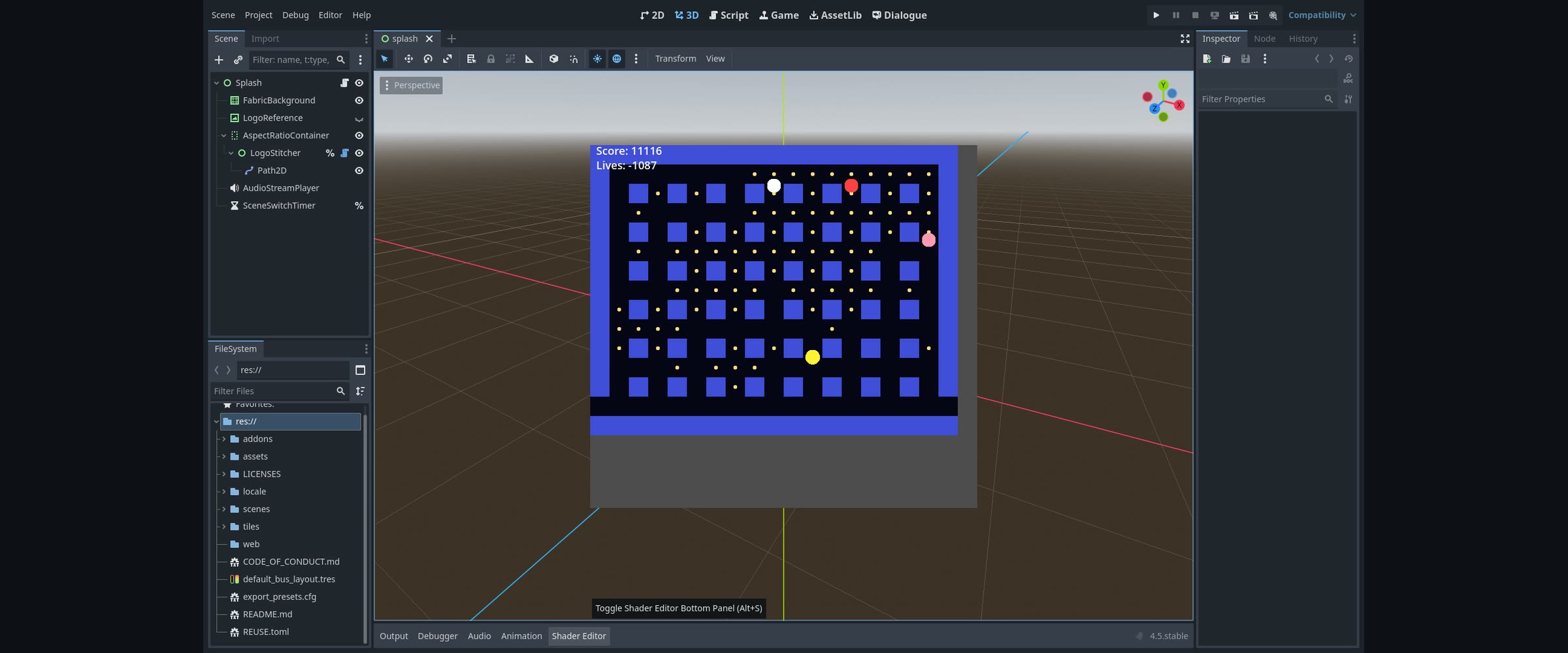
From one prompt to a running game
Hcompany’s Holo4 27B agent built a Pac-Man-style maze game in Godot and left it running without keyboard input. The company’s example records 68 tool calls, 2.4 million tokens and 268 lines of code. The final game includes walls, pellets, a player marker, chasing ghosts, score and lives.
The player uses a simple heuristic: it moves toward the nearest pellet unless a ghost is close, in which case it moves away. The model built and launched the app; this is not a demonstration of a language model learning to play Pac-Man.
A model that can switch interfaces
Holo4 is a family of open-weight models that Hcompany says can work through a graphical interface, code, MCP and APIs. Its 27B and 35B-A3B versions are available, along with quantized model files and trajectories. The same general model can act on a desktop, the web, Android or in a code sandbox.
The Pac-Man task is a concrete example of long-horizon software work: create several parts, run the application and leave it in a usable state. The source page also shows a 3D Eiffel Tower model and company-logo build, so the game is one example rather than the whole capability.
What the comparison does—and does not—show
Hcompany reports that the same Pac-Man prompt took Qwen3.8 27B 197 calls, 11.4 million tokens and 327 lines in its harness, compared with 68 calls and 2.4 million tokens for Holo4. This is the company’s own side-by-side run and depends on the agent harness as well as the model.
The source includes downloadable trajectories, model weights and the video demonstrations. That makes it possible for builders to inspect the sequence of actions instead of judging the result from a finished-game screenshot alone.
Source published September 28, 2026. Coverage is based on the maker’s announcement and demonstration.