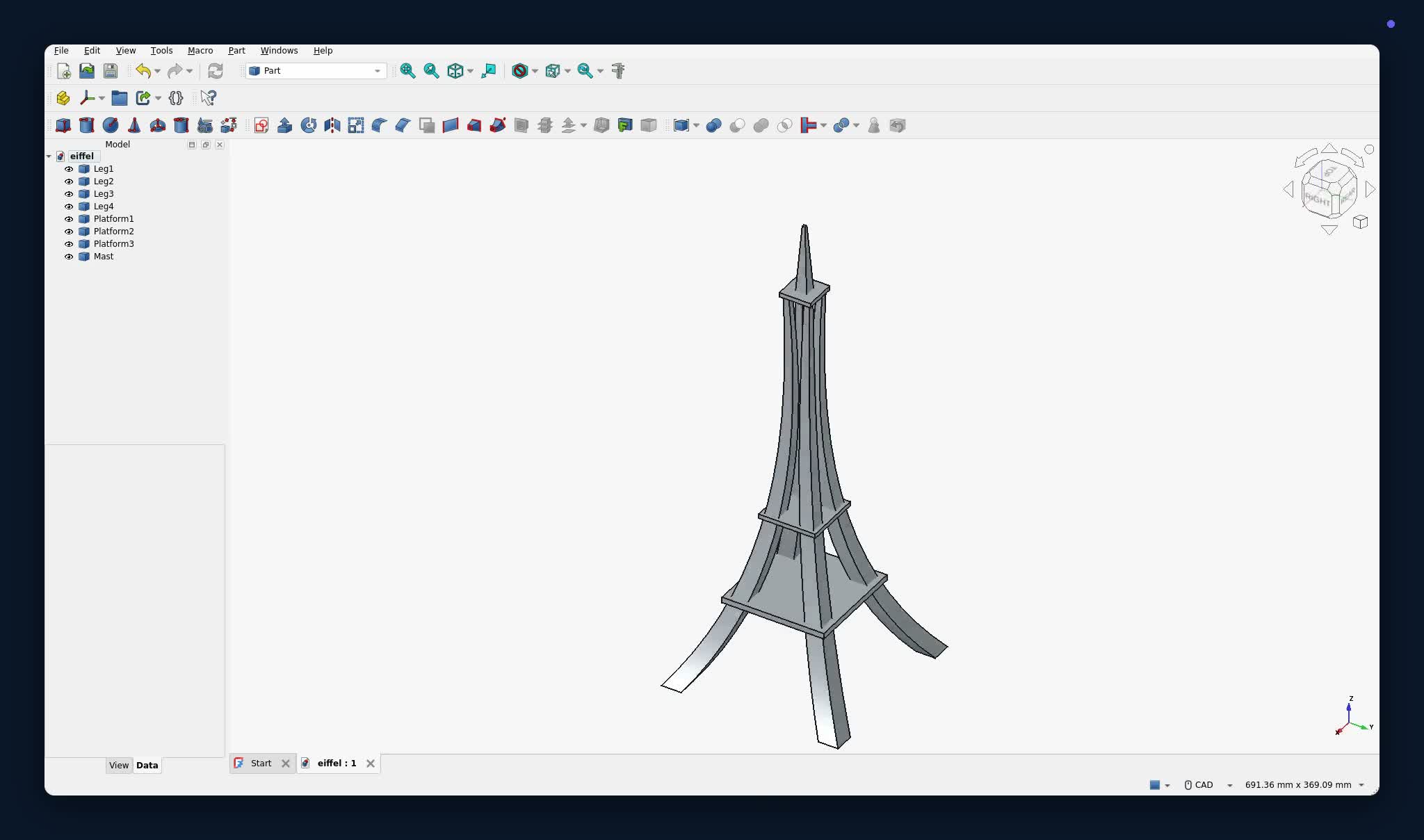
The result is a project file, not a picture
H Company gives Holo4 a detailed Eiffel Tower specification and asks it to work in FreeCAD. The published run ends with a three-dimensional model that can be rotated and inspected in the CAD application. The agent is operating software and producing an artifact, rather than returning a single generated image.
This is not a complete engineering model or a ready-to-build structure. It is a visible example of a model moving through a desktop tool, and H Company publishes the trajectory so readers can inspect how it got there. Source: https://huggingface.co/blog/Hcompany/holo4
The trace shows the cost of persistent agents
H Company reports the Eiffel Tower example used 84 calls and 1.3 million tokens. That is a long workflow, not an instant prompt-to-CAD trick. Holo4’s product claim is that one model can work through a GUI, write and run code, and use MCP tools or APIs as the task requires.
Holo4 comes in 27B dense and 35B-A3B versions. The company says weights are available through Hugging Face and the model can be used through its API.
Benchmark claims are separate from the demo
H Company reports 61.7% for Holo4 27B on OSWorld 2.0 and 30.9% for Holo4 35B-A3B, compared with 81.8% for Opus 5.5. It cautions that model releases, harnesses and subsets differ. The company also publishes trajectories behind its benchmark claims.
The trajectory is the most inspectable part of the Eiffel Tower example. Independent attempts on changed prompts and hardware would show how repeatable the CAD result is. Source: https://huggingface.co/blog/Hcompany/holo4
Source published September 28, 2026. Coverage is based on the maker’s announcement and demonstration.