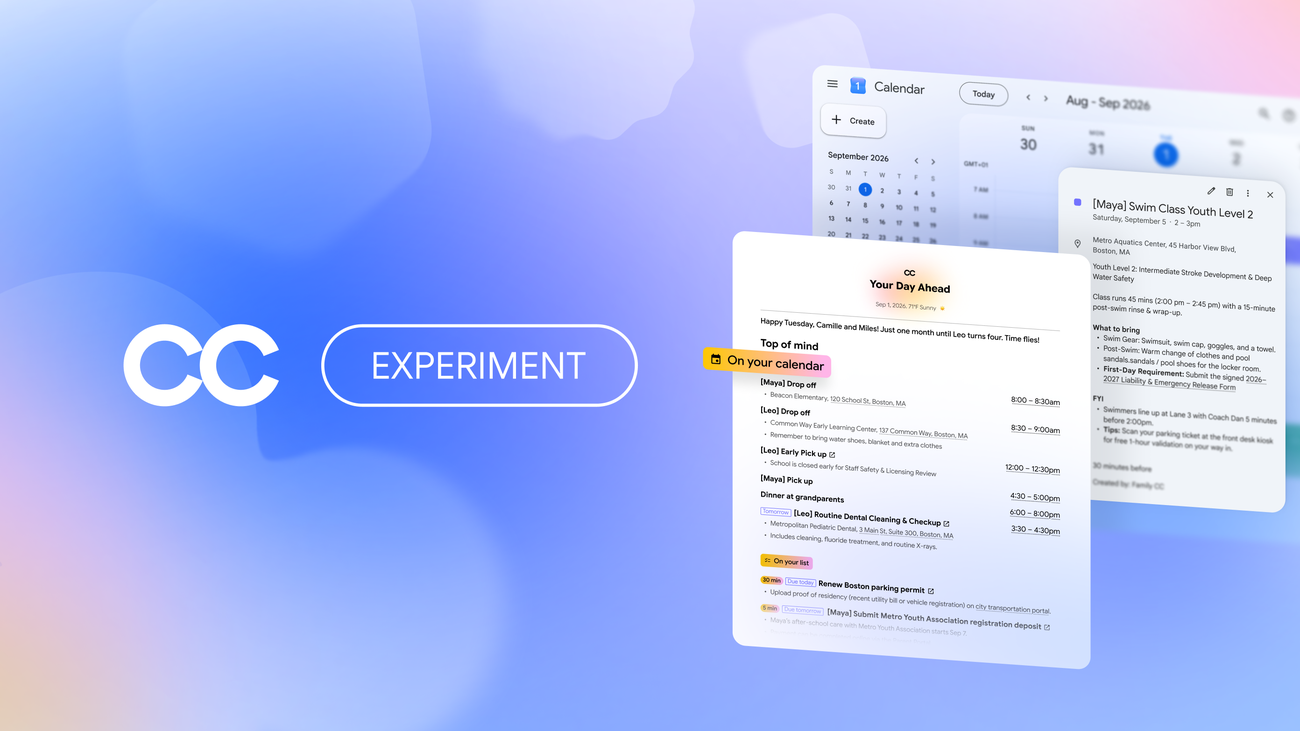
The agent has a place to work
Google Labs’ September17 CC announcement describes an agent with its own Google account and isolated cloud computer. Up to six household members can share selected information. Gemini models and Google’s Antigravity agent harness support the work. This is an early U.S. experiment for adults with personal Google accounts, with an upgrade invitation or waitlist.
The capability shift worth noticing is shared context. A useful group assistant needs to distinguish what everyone should know from what belongs to one person. Otherwise, a faster summary simply reproduces the confusion of several separate inboxes.
From an invite to an action
Google’s examples include turning shared information into calendar events and task lists, as well as helping prefill registration PDFs. Members choose what to share; external action or information sharing requires permission. The announcement also describes group memory and a shared daily briefing.
A practical test would begin with one non-sensitive event. Give the agent the time, location and participants, then inspect the resulting calendar entry. Change the time in the source and check whether the update reaches the same event, rather than creating a duplicate. That tests coordination instead of just text generation.
The question to keep asking
Did the agent reduce the work you had to do afterward? A clear draft can be valuable even when it needs approval. A confident entry with the wrong participant or outdated time can cost more effort than making it yourself.
CC is interesting because the work moves across an account, shared context and applications. Those connections are where an agent can become useful—and where a small, observable trial is more informative than a long feature list. The attached image is Google’s product illustration, not our own completed task.
Primary sources
https://blog.google/innovation-and-ai/models-and-research/google-labs/cc-expanding-to-groups/
Source published 2026-09-17. Coverage is based on the maker’s announcement and demonstration.