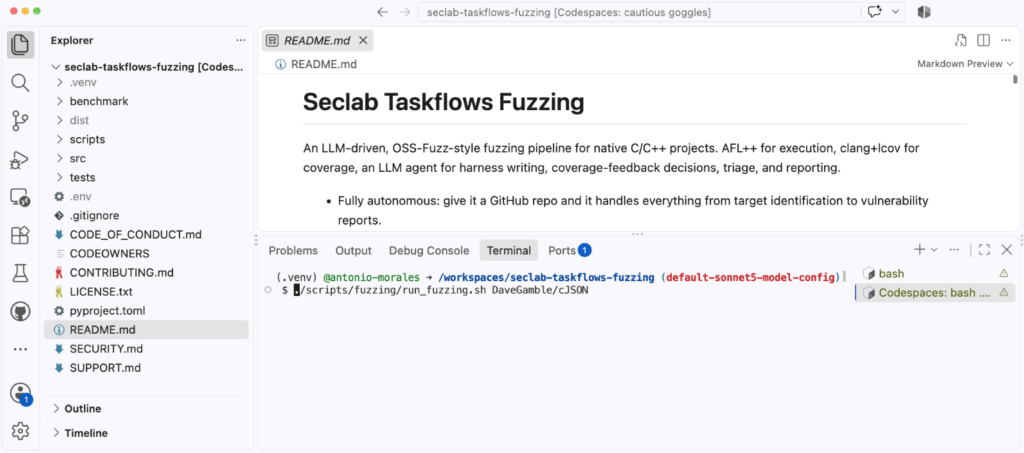
From repository to fuzzing loop
Fuzz testing feeds unusual inputs into software to uncover crashes and other unexpected behavior. It can be powerful, but getting started often means understanding the project’s build system, choosing entry points and writing harness code that exercises the right functions.
GitHub Security Lab’s Taskflow Agent is designed to automate much of that setup for public C and C++ repositories. It analyzes the build, identifies candidate entry points, creates fuzzing harnesses and runs AFL++, a widely used fuzzing tool.
It can use coverage to improve its work
The agent is intended to run as a loop rather than a one-shot code generator. It reads coverage information, revises harnesses and triages crashes into reports with reproduction details. That gives a developer a more complete starting point than an isolated suggested test file.
The shown report is an output format for a possible finding; it is not proof that the tool has discovered a confirmed vulnerability in a specific product. GitHub describes a research workflow, and security findings still need human validation and responsible follow-up.
The environment warning is part of the story
The agent runs project build commands while analyzing a repository. Those commands can execute arbitrary code, which makes an unfamiliar repository a meaningful security risk. GitHub explicitly recommends using a disposable environment such as a Codespace rather than a personal or production machine.
That caveat is not a small footnote: it determines where the tool is safe to try. Treat the repository as untrusted, isolate the run, and inspect the report before acting on it. Automating security work does not remove the need for secure lab conditions.
A practical use for coding agents
This is a concrete example of an agent doing tool-mediated work: inspect a codebase, prepare a test plan, run tools, adjust based on results and produce a report. The useful measure is not how much code it writes, but whether its harnesses reach meaningful code paths and produce reproducible cases.
For maintainers, a generated fuzzing setup could reduce the initial cost of testing a complex project. The next question is whether it finds issues that existing tests miss, and how consistently people can reproduce the results. GitHub’s workflow makes that evaluation possible; it does not make it unnecessary.
Source published 2026-09-24. Coverage is based on the maker’s announcement and demonstration.