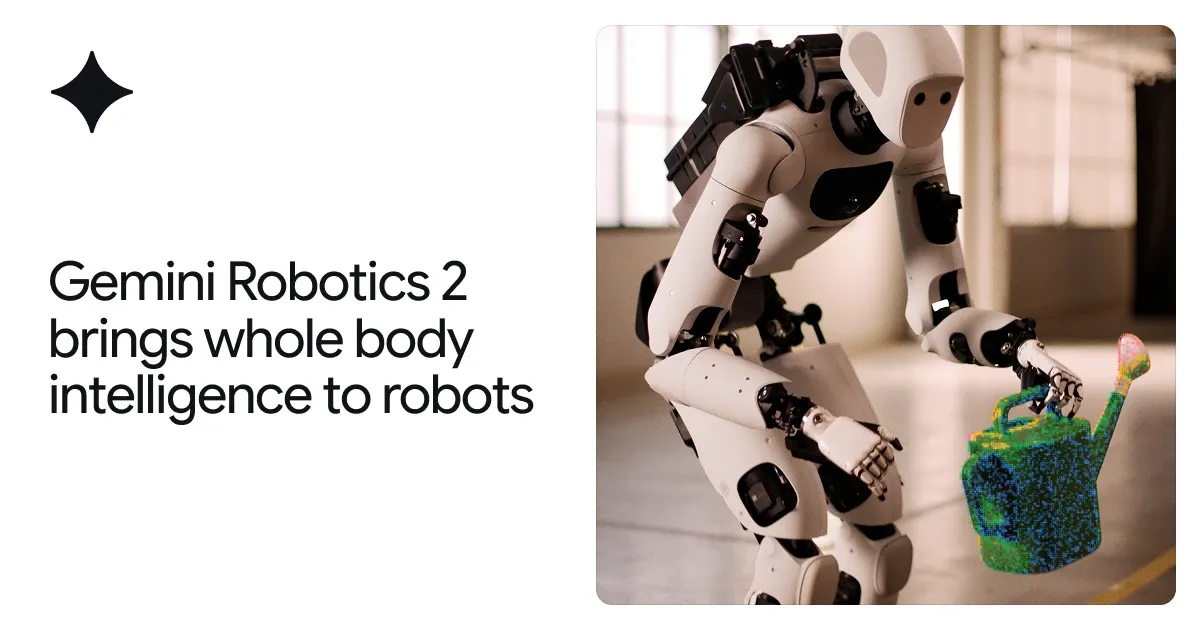
A demonstration worth revisiting
Google DeepMind’s Gemini Robotics 2 report shows the same model checkpoint working on three embodiments: Apptronik Apollo 2 with SharpaWave hands, Apollo 2 with Inspire hands, and Franka Duo with a Robotiq gripper. That is a harder claim than mastering one robot in one room, because the bodies differ in reach, hands and movement.
In one example, Apollo responds to an instruction to put a watering can in a green bin on a lower shelf. It walks to the object, picks it up, moves to the shelves and places it at the destination. DeepMind describes this as a shift from upper-body tabletop control toward coordinated whole-body behavior.
Hands and planning
The project also demonstrates fine actions with a five-fingered hand, including tying a bag and sealing a ziplock. Its embodied-reasoning model can break a longer request into steps and track progress while the action model handles movement. DeepMind reports multi-robot collaboration and an on-device model designed for lower-latency local control.
The published task results show the remaining challenge. On its Apollo Sharpa hand tests, unscrewing a bulb reached 92%, while tying a trash bag reached 44% and using a dustpan 32%. DeepMind explicitly says multifinger dexterity remains difficult, even where whole-body and gripper tasks perform better.
What changed over time
Earlier robot systems were often trained for a narrow embodiment and environment. Gemini Robotics 2 is an example of researchers trying to share perception and action knowledge across hardware. The report is from July, so this is a capability comparison, not a claim of a new September launch.
The next meaningful test is whether cross-body transfer survives unfamiliar workplaces, varied objects and long operating hours. A dramatic video moment is useful evidence of what a system can do; published success rates reveal what it still does inconsistently. Both are needed to judge progress toward general-purpose robots.
Source published 2026-07-30. Coverage is based on the maker’s announcement and demonstration.