Four projects make the model’s “reasoning” claim visible
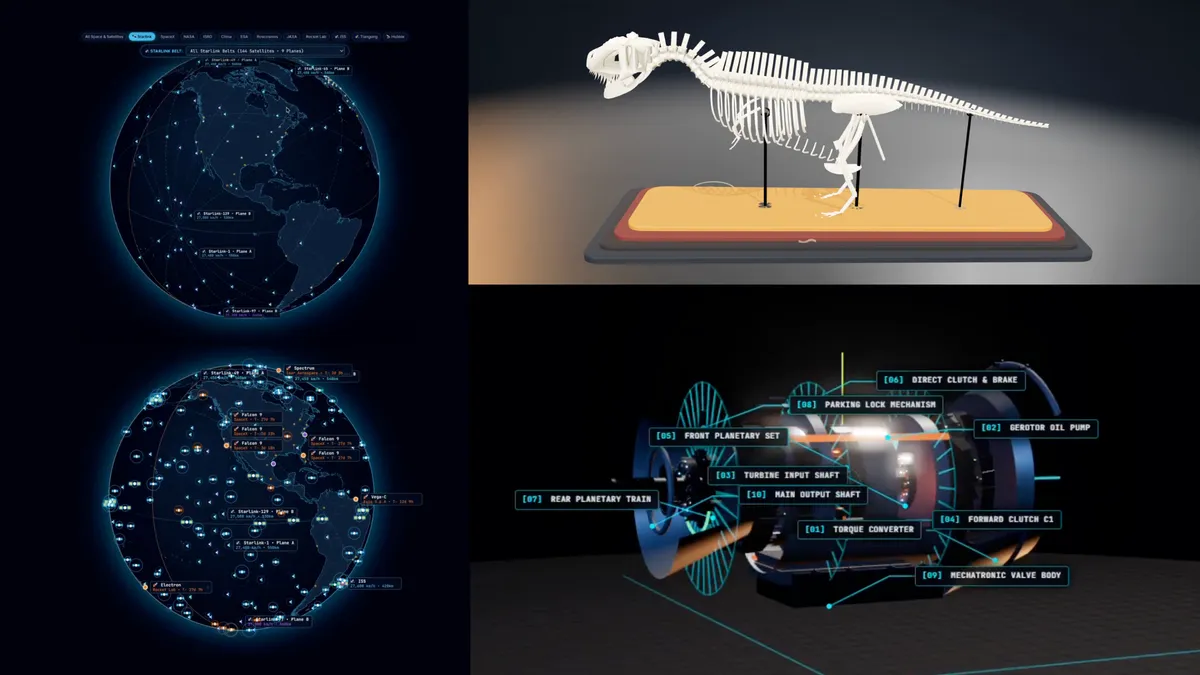
Google’s Gemini 3.8 Flash release is easier to understand through what builders made with it. The examples include a live orbital simulation, an animated ink painting, a detailed dinosaur skeleton and an interactive automatic-transmission model. Each turns model capability into something a reader can inspect rather than a score alone.
These are community demonstrations highlighted by Google, not controlled tests. The common thread is that each project asks the model to reason across a sequence: understand the request, use tools or code, and produce a visual result that can be explored.
From satellite paths to a moving ink painting
Ashutosh Shrivastava paired Gemini 3.8 Flash with Google Antigravity to map the live paths of satellites, space stations and orbital rockets. That moves beyond a static chart: the output is a simulation of objects moving through orbit. Google’s post does not claim independent validation of the orbital calculations, so the visualization should be treated as a builder demo rather than a scientific instrument.
Noctus used the model’s multimodal capabilities to animate Seigaiha waves, a traditional Japanese pattern. The result turns an image style into motion. Together, these examples show two different kinds of output: a data-driven visualization and a visual interpretation of an artwork.
A dinosaur with explicit checks, and a transmission you can explore
Emily asked Gemini to create a T. rex skeleton through a four-phase prompt with strict requirements, banned shortcuts and accuracy checks. That matters because visual generation can look convincing while quietly getting details wrong; explicit checks make the request inspectable, though the post does not provide a paleontologist’s validation.
Hakm built an automatic-transmission prototype with ten camera views, four display modes, labels and a side panel that explains clicked parts. This is the most immediately useful interaction demo: the viewer can rotate through an engineered object and learn about components instead of seeing a single render.
What these builds actually say about Gemini 3.8 Flash
Google describes 3.8 Flash as a workhorse model that “works harder” on complex tasks by reasoning through extra steps and calling tools iteratively. The four projects illustrate how that can help in software and visualization work: the model is not just answering a question but helping assemble a small tool or explorable artifact.
The limits are important. These are selected examples from a company showcase, not a benchmark of success rates across all users. In particular, the satellite visualization and dinosaur model need domain validation before their outputs should be trusted as factual. Google’s full article and links to the builders are here: https://blog.google/innovation-and-ai/models-and-research/gemini-models/gemini-3-8-flash-developers/.
Source published September 28, 2026. Coverage is based on the maker’s announcement and demonstration.