A robotic hand can be impressive without being autonomous
Clone Robotics’ hand clip shows finger movement under teleoperation. That makes the video useful evidence of the hardware’s range, but it should not be mistaken for a robot independently deciding how to manipulate an object. The company describes an anthropomorphic hand powered by artificial muscle fibers and presents teleoperation as one way to show its movement.
The distinction matters because a dexterous hand is only one part of manipulation. A complete system also needs perception, planning, force control and recovery when an object moves or a grasp fails. The clip lets viewers inspect the fingers directly; it does not establish autonomous task performance. Source: https://www.clonerobotics.com/hand/
HumanEgo transfers task information from human video
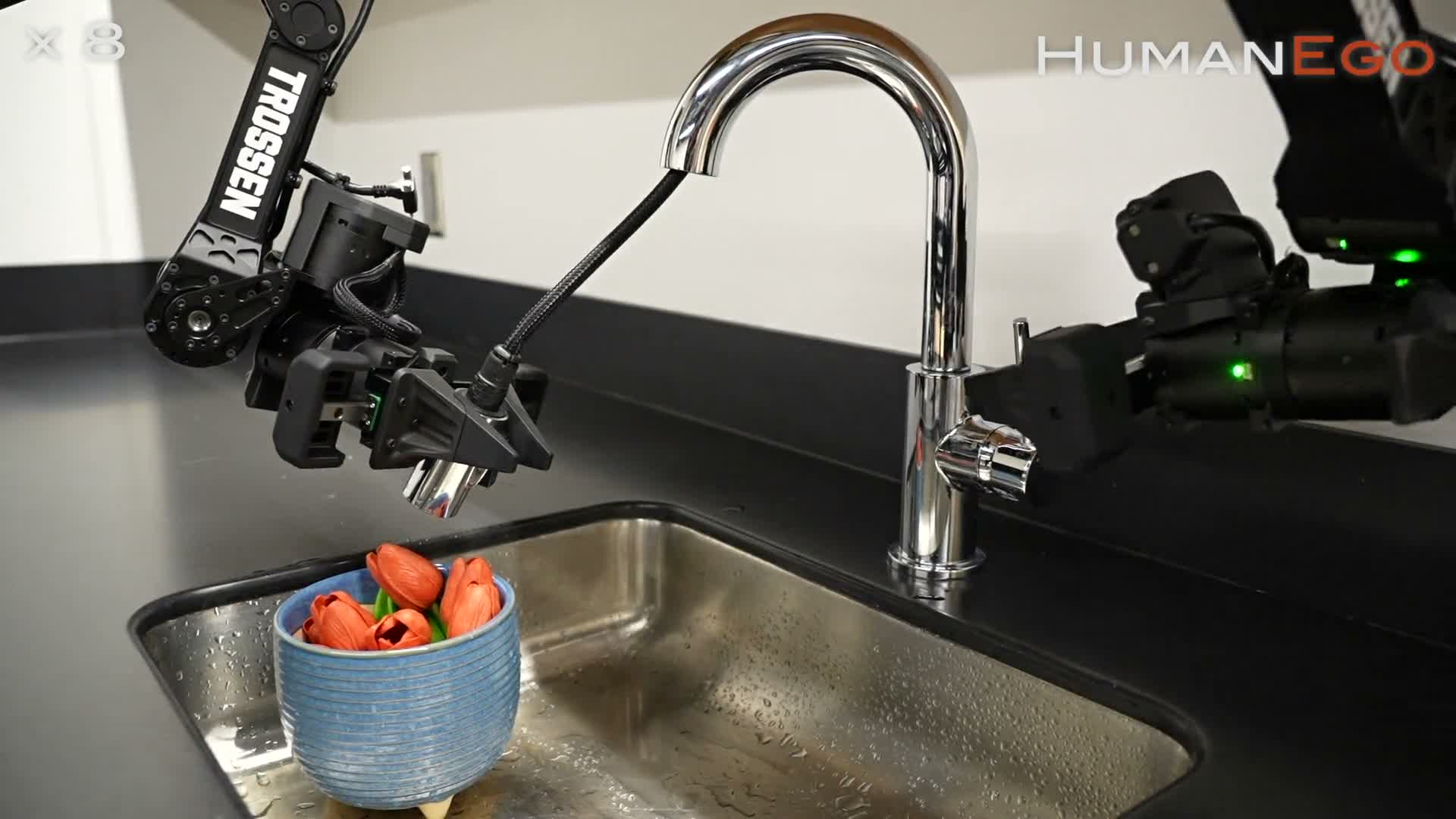
HumanEgo takes deliberately recorded egocentric demonstrations, tracks hand pose and scene geometry, then uses that information to train a robot policy. Its project page shows a real robot completing tasks including watering flowers. The authors report strong results from a small amount of human demonstration data across four tasks.
This is more structured than simply asking a model to learn from arbitrary internet video: the demonstrations include calibrated tracking and task-specific action signals. The project also releases 122 recordings for two tasks. The results are the authors’ evaluation, not evidence that any everyday video can directly teach a robot. Source: https://humanego-ai.github.io/
SAIL spends more computation before the robot moves
Sakana AI’s SAIL method generates possible robot trajectories, tests them in simulation, scores task progress and revises promising candidates before sending a selected trajectory to a physical robot. The researchers report a rise from 25% to 73% successful trajectories as the search budget increases from one to 45 nodes across six simulated manipulation tasks.
The important design choice is where the extra reasoning happens: candidate failures can be examined in simulation before the physical arm acts. The project also demonstrates a physical robot, but the headline 25%–73% comparison is from the six-task simulation evaluation. The published physical clip is marked 2× speed. Source: https://pub.sakana.ai/sail/
HumanEgo shows a second task: serving bread
A second HumanEgo source clip shows an arm serving bread. That gives the roundup two concrete tasks from the same research project: tending flowers and handling food. HumanEgo’s method uses tracked first-person human demonstrations to train robot policies, rather than assuming a general video model can learn directly from arbitrary internet footage.
The HumanEgo paper and project page report the authors’ results across four real-world tasks. These two clips make the task-level behavior visible, while the evaluation and data pipeline explain what is behind the demo. Source: https://humanego-ai.github.io/
The useful comparison is the part of the stack each demo tests
These examples answer different questions. Clone shows what the fingers can do when controlled; HumanEgo studies how a robot can learn tasks from structured human demonstrations; SAIL searches candidate motions before execution; Atlas shows a hand designed around tools and contact sensing. None alone solves general-purpose manipulation.
Taken together, they make a better watch list than a single “robot hand” headline: look for what was controlled by a person, what was learned, what was tested in simulation, and what the robot completed in the physical world. That is the difference between a striking hardware clip and evidence about a working manipulation system.
Source published October 2026. Coverage is based on the maker’s announcement and demonstration.