The result
Black Forest Labs introduced FLUX 3 Action, a 7-billion-parameter world action model. It takes camera imagery, the current action state and a text instruction, then predicts future video frames together with robot actions. A call returns 32 actions, covering roughly the next two seconds. During control, the system can execute a few actions, observe what happened and plan again.
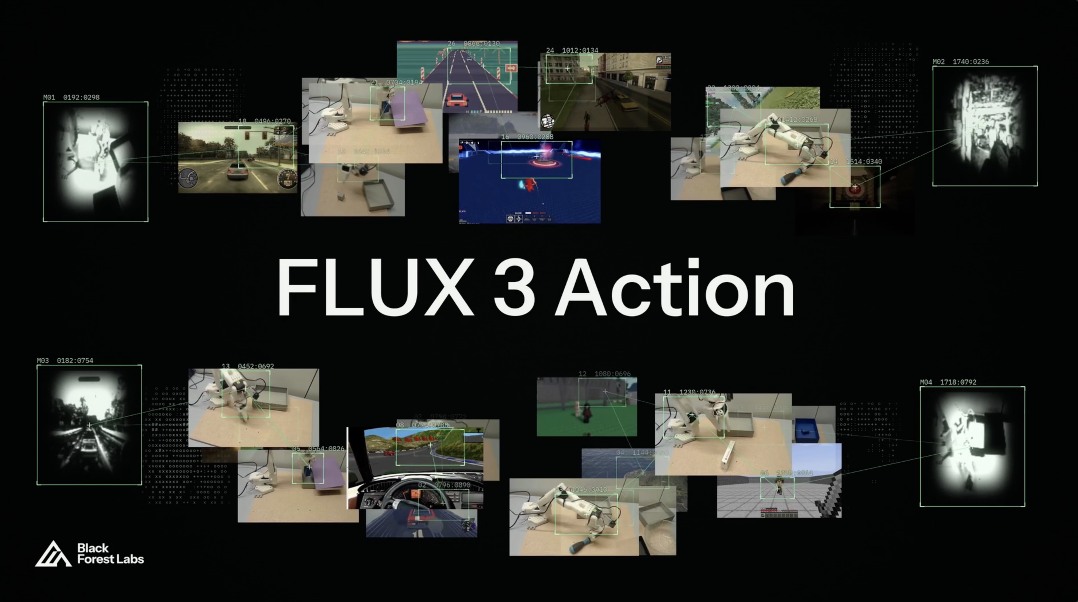
The company demonstrated the model with a SO-101 robot arm through LeRobot, as well as in video games and on an indoor drone. These are different kinds of control problems, so the release is more interesting than a model trained for one tightly staged reach-and-grasp clip. The maker has published model weights, code and task-specific checkpoints.
What the evidence shows
After fine-tuning on the DROID robotics dataset, Black Forest Labs reports 42.92% overall success on RoboLab-120, compared with 36.8% for the 16B Cosmos 3 Nano policy in its published table. This is a benchmark comparison under the stated evaluation, not a guarantee that a real arm succeeds in every unfamiliar home or factory.
The SO-101 demonstration matters because it leaves the screen and touches a physical setup. The maker says fine-tuning used about 200 teleoperated episodes. Its clips show the arm responding to changed object positions and containers; those videos are sped up fourfold and omit planning pauses, so the displayed speed is not real-time performance.
Why builders should care
A policy that predicts both what the world will look like and what action produced it may be easier to adapt across tasks than a narrow hand-coded routine. Replanning after short action chunks also gives the robot a chance to correct when objects move or a grasp differs from expectation.
The weights are released under the FLUX Kommunity License, which has conditions, while the training code is public. Teams should read the license and measure latency on their own hardware before treating the model as a drop-in robot brain. The milestone here is a reusable research starting point with actual embodied demonstrations.
Source published 2026-09-23. Coverage is based on the maker’s announcement and demonstration.