From simulated workflow to physical arm
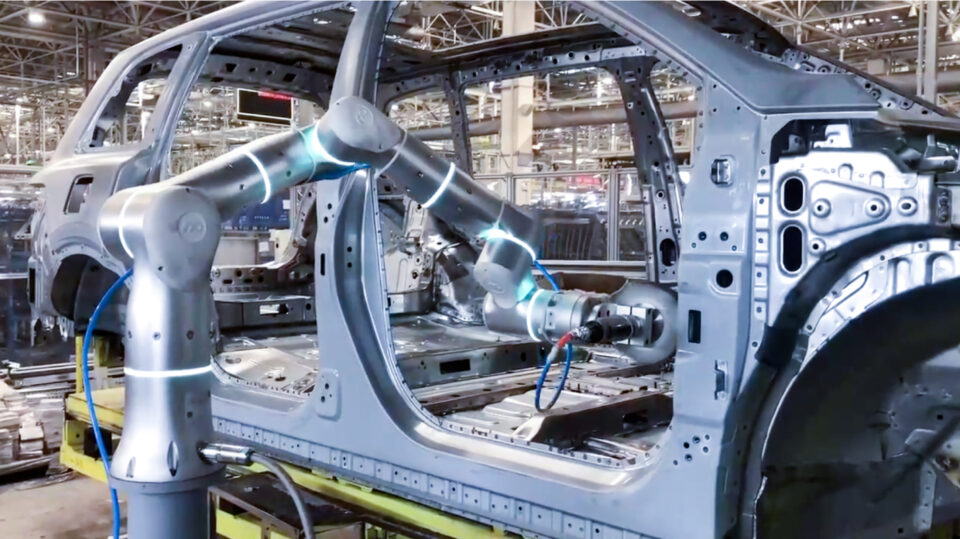
Flexiv is integrating NVIDIA Isaac ROS with its Rizon 4 adaptive industrial robot. NVIDIA describes a path for developers to test an application in Isaac Sim and then deploy it onto physical hardware, with the source image showing a welding arm in an automotive factory.
Simulation is useful because developers can test perception and motion planning without immediately risking equipment or slowing a line. But an application that works in simulation still has to deal with the variability, timing and safety requirements of a physical factory.
What the integration promises
The Rizon 4 is an adaptive robot arm, and the Isaac ROS ecosystem supplies GPU-accelerated perception and robotics packages. Bringing them together could make it easier to carry software workflows from development into deployment without rebuilding every component for a different toolchain.
NVIDIA’s announcement presents this as an integration and streamlined development path. It does not publish a production throughput result, a deployment count or a quantified reduction in integration cost. Those outcomes will depend on the welding cell and the application being built.
Why welding is a revealing task
Factory welding illustrates the gap between a robot arm moving through a planned path and a production system that can adapt to real parts and conditions. Developers must coordinate perception, position, motion and process controls, then prove that the resulting operation stays within safety requirements.
A simulation-to-hardware workflow can help teams catch some problems early, but it cannot replace commissioning on the production equipment. The useful promise here is a more direct software path from test environment to the adaptive robot, not automatic deployment without engineering.
A practical marker for robotics software
The broader question is whether open robotics software can reduce the cost of connecting tools, sensors and hardware across different manufacturers. If a workflow carries more cleanly from simulation to the shop floor, developers can spend more time validating the task and less time rewriting infrastructure.
The Flexiv example is an early marker, not yet a before-and-after study. Future evidence would include the applications shipped, the time to commission them and how reliably the system handles real production variation.
Source published 2026-09-22. Coverage is based on the maker’s announcement and demonstration.