The demonstration
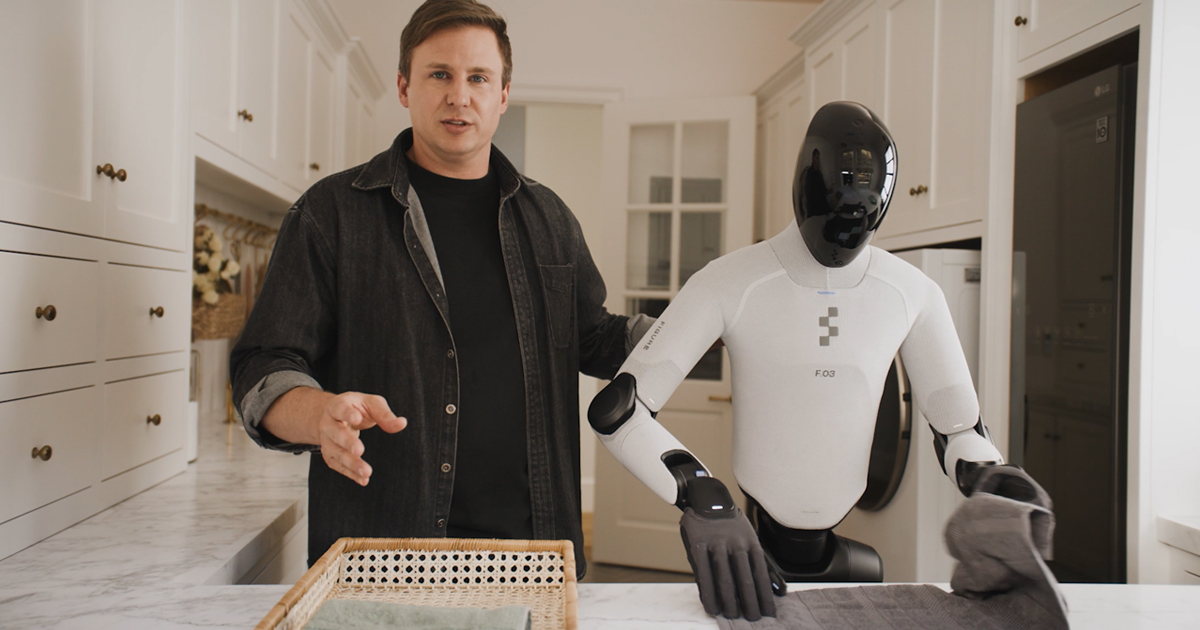
Figure reports that its Helix 2.5 system performed three whole-body behaviors across 30 previously unseen Bay Area homes: tidying living rooms, folding towels and making beds. The company says it collected no data in the evaluation homes and did not fine-tune the policies on those rooms or their objects.
The tasks require more than arm movement. A humanoid must perceive a cluttered space, walk to an object, position its body, use both hands and sometimes recover from an awkward move. Figure’s videos show the robot adjusting its stance and moving around furniture while completing multi-step work.
What the numbers mean
Figure compared policies trained with the same task-specific data, changing whether the base model had been pretrained on its Index dataset of human behavior. In its blind evaluation, the model without that pretraining succeeded on 9% of zero-shot trials; the pretrained model succeeded on 56%. Success required finishing the entire task, with no partial credit.
The company says Helix 2.5 used half as much task-specific data as a representative Helix 02 behavior while generalizing across 30 homes. These are Figure’s own experiments and definitions of success, but the controlled pretraining comparison makes the result more informative than a single polished demo clip.
Why this is a harder robot test
Traditional robot demonstrations often happen in a familiar room with carefully chosen objects. New homes change the geometry, lighting, clutter and available surfaces. A policy that carries a learned behavior into a new room is closer to what a broadly useful household robot would need.
A 56% full-task success rate still means many attempts fail, so the result is a research milestone rather than a ready household service. The next questions are reliability across more homes, safety around people, speed and whether the same base policy can handle many more chores without a separate adaptation project for each one.
Source published 2026-09-17. Coverage is based on the maker’s announcement and demonstration.