The new hand is designed to do more than close around objects
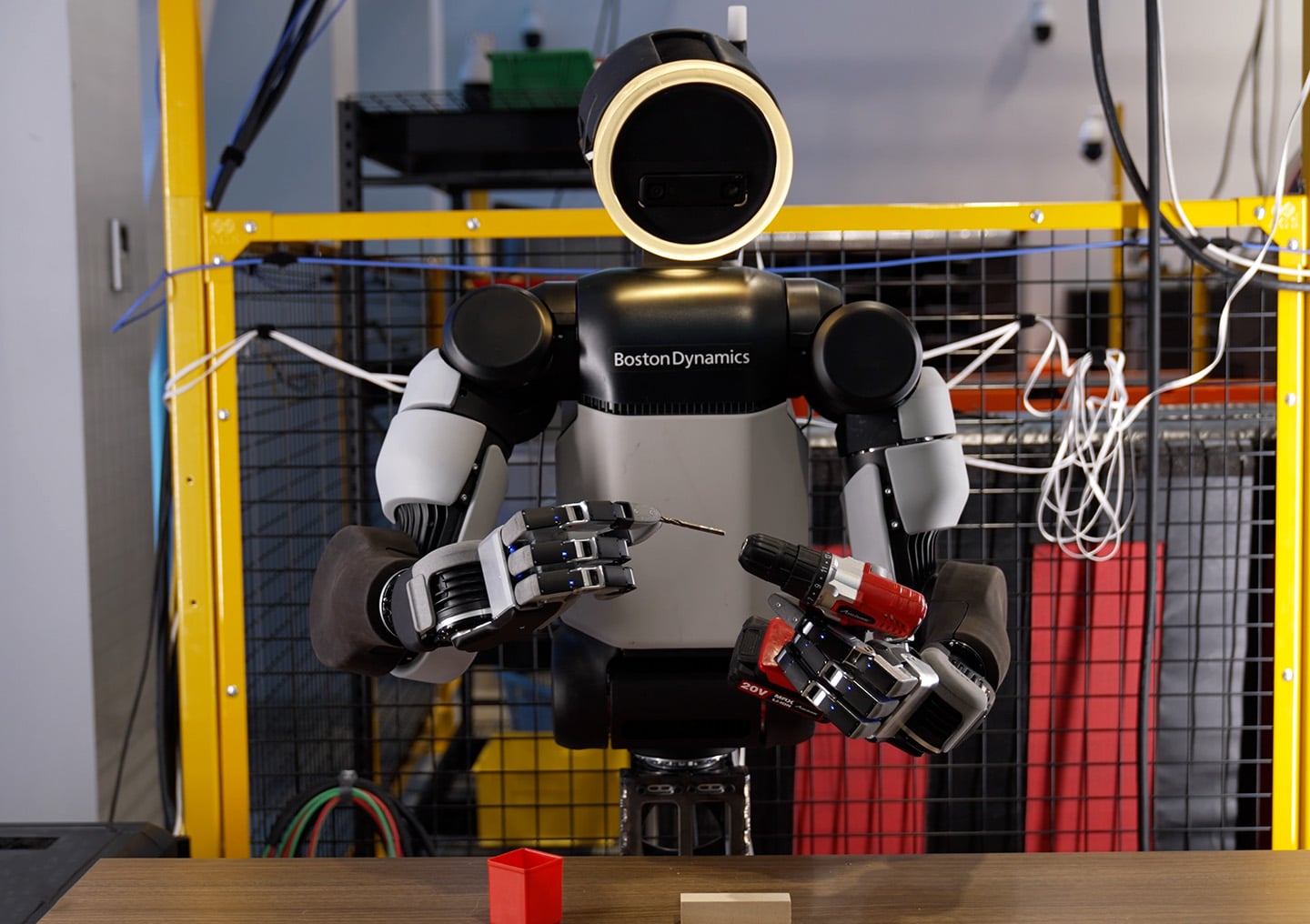
Boston Dynamics says the new Atlas hand has four fingers and 13 degrees of freedom, up from seven in the prior design. It uses direct actuation and dense pressure sensing across the fingertips and palm. The company’s source video shows Atlas handling a drill and changing a bit.
This is a hand-design story about manipulation: the robot needs to adjust an object after grasping it and operate tools whose triggers and handles were designed for people. Boston Dynamics says the four-finger arrangement, including a four-DOF thumb, supports several pinch and tool grasps.
The demonstration is teleoperated
The source clip labels the tool-handling sequence “Teleoperated.” It demonstrates the hardware’s range and the ability of a person to direct the robot through a tool task; it does not show Atlas autonomously performing factory work.
That distinction makes the video more useful, not less: it shows what the hand can mechanically do today and separates it from the autonomy research still required for deployment. Boston Dynamics says the hand is designed for high-fidelity simulation and sim-to-real reinforcement learning.
Why leave out a fifth finger?
Boston Dynamics says an extra finger would add three actuators, with more cost, volume and failure opportunities. Its stated design goal is reliable tool use in spaces and with equipment built for people, while keeping the system practical to manufacture and maintain.
The company’s trade-off is clear: a four-finger hand with an opposable thumb and tactile sensing rather than a literal human replica. The next evidence to watch is a broader set of tasks, repeatability and how manipulation skills transfer from simulation to real hardware.
Source published October 1, 2026. Coverage is based on the maker’s announcement and demonstration.