The move
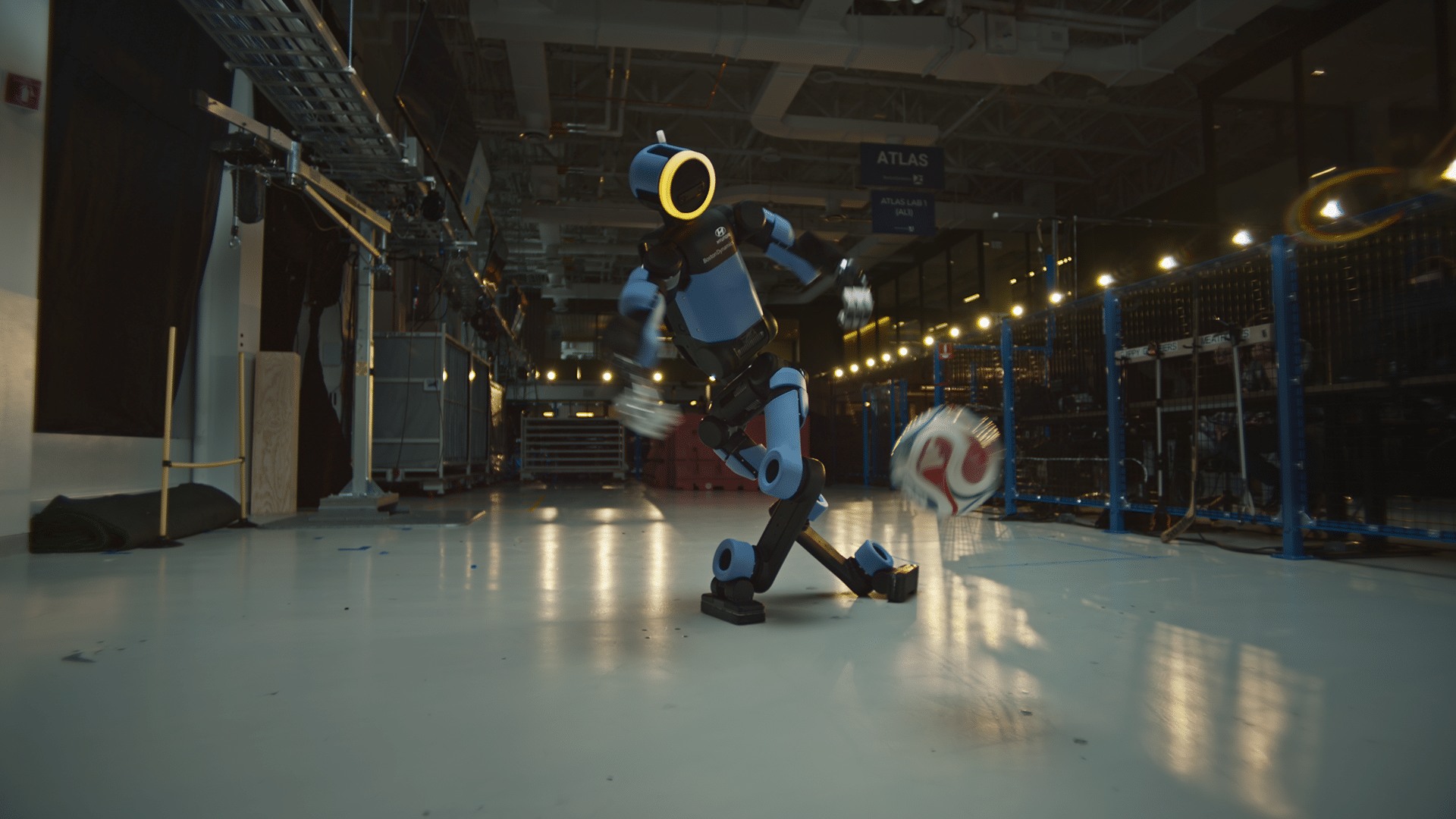
Boston Dynamics and Hyundai showed Atlas performing a Ghost Rabona as part of a football campaign. The robot approaches the ball, fakes a shot with its left leg and strikes with its right leg crossed behind. It is a visually playful demonstration, but the sequence combines balance, timing, acceleration and recovery in a way a simple straight kick does not.
A convincing fake requires speed; the crossed-leg strike changes the robot’s support and momentum; landing requires it to regain control. Boston Dynamics says this pushes the same whole-body agility needed for robots that move powerfully in less staged environments. The source video lets viewers see the actual sequence rather than infer it from a benchmark.
How it was learned
The company says it used human motion reference and reinforcement learning. Atlas practiced extensively in simulation to learn how its body behaves while imitating the motion. That pairing matters because a human can show the desired movement, but the robot must find a version that works with its own joints, mass and balance.
Boston Dynamics frames this as training a previously unseen trick shot, not as a preprogrammed animation played through motors. The process resembles an athlete studying a move and repeating it, with simulation providing many low-cost trials before the behavior reaches physical hardware.
What this demonstrates
A trick shot is not an industrial task, and the clip does not establish that Atlas can play a match or work safely beside people all day. Its value is as a stress test for mobility: rapid leg switching, torso coordination and recovery after a dynamic contact with a ball.
Placed beside the mini-fridge lift, the demonstration shows two different edges of humanoid capability: forceful manipulation of a bulky object and agile whole-body movement. A useful robot will eventually need both, repeated reliably outside a curated demo. For now, Atlas makes that direction unusually easy to see.
Source published 2026-06-04. Coverage is based on the maker’s announcement and demonstration.